

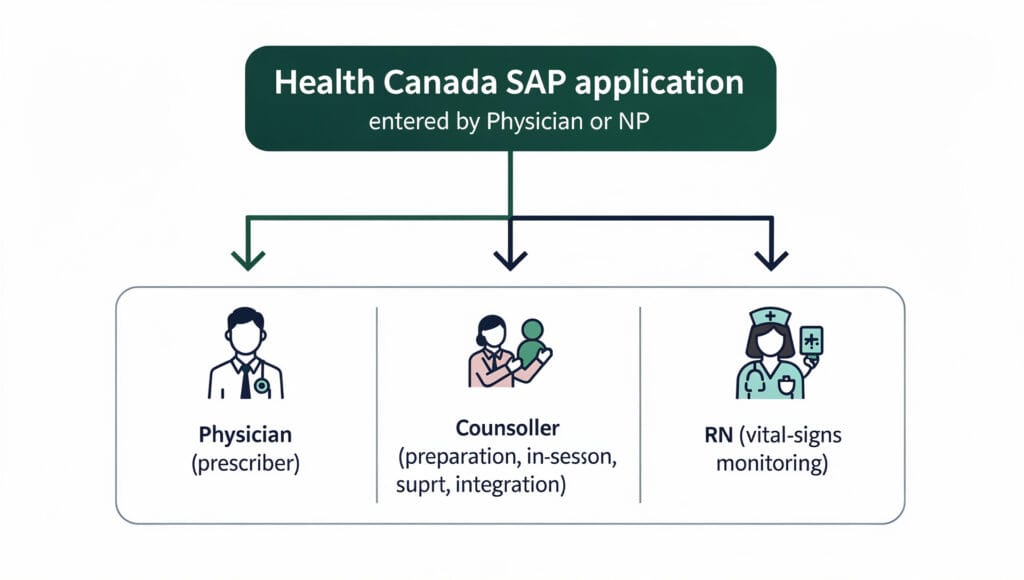
Canadian counsellors , Canadian Certified Counsellors (CCCs), Registered Clinical Counsellors (RCCs), Registered Counselling Therapists (RCTs), and counselling therapists in unregulated provinces , can train in psychedelic-assisted therapy and contribute meaningfully to multidisciplinary PAT teams. Counsellors cannot prescribe, administer, or apply through Health Canada’s Special Access Program; their role is preparation psychotherapy, supported facilitation during dosing sessions, and integration. This guide covers the specific scope rules, ketamine-assisted therapy as the most accessible entry point, CCPA and BCACC continuing-education recognition, training programs in Canada, and how counsellors integrate into supervised clinic models.
Key takeaways
- Canadian counsellors cannot prescribe, dispense, or administer any psychedelic medicine and cannot apply through Health Canada’s Special Access Program [BCACC 2024]. Authority for prescribing and SAP applications rests with physicians and nurse practitioners.
- Counsellors can deliver preparation psychotherapy, support clients during dosing sessions within sanctioned programs depending on the provincial rules and regulations.
- Ketamine-assisted psychotherapy is the most immediately accessible PAT context for trained counsellors in Canada because ketamine is an approved medicine with off-label psychiatric prescribing under provincial-college rules.
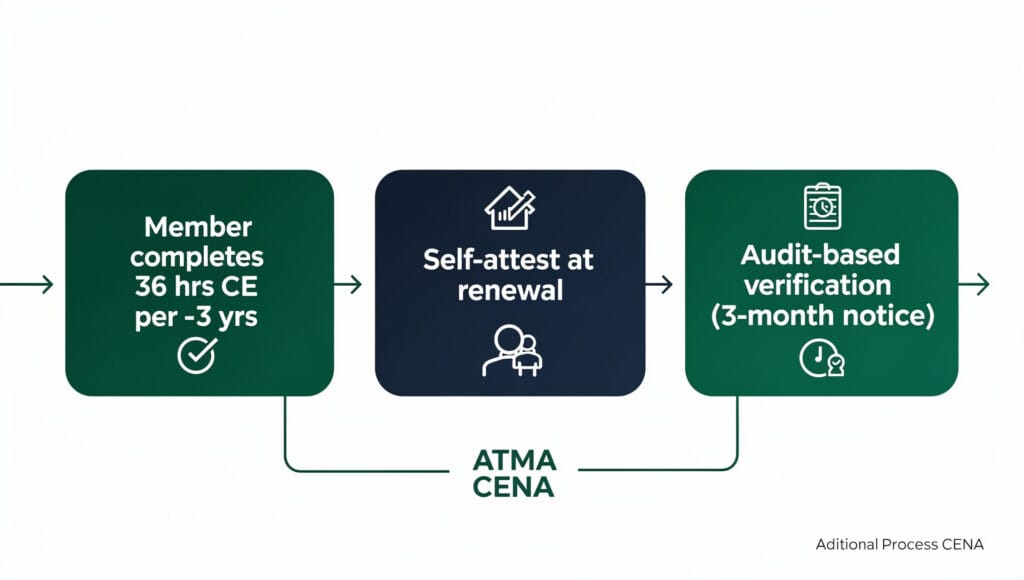
- CCPA’s Continuing Education Trust System (effective January 2025) maintains the 36-hour-per-3-year requirement; trust-based renewal replaces mandatory CEC submission unless audited.
Not sure which pathway fits your counselling designation and province? Book a free information call with a clinical advisor.

Can Canadian counsellors practice psychedelic-assisted therapy?
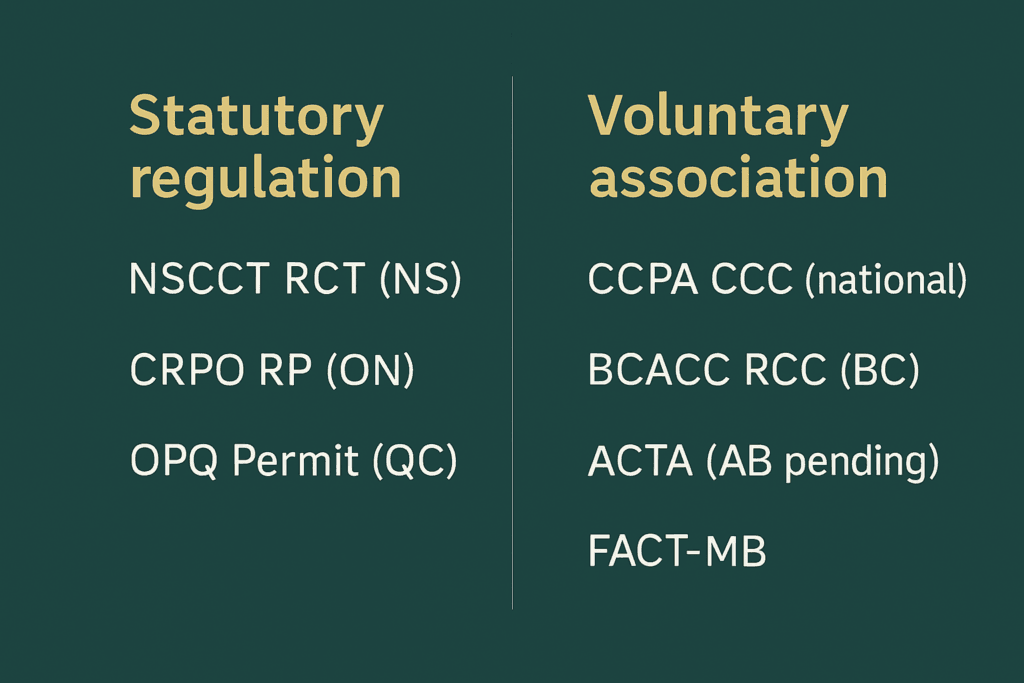
Yes , within scope. Canadian counsellors operating under regulated designations (RCC in BC, RCT in Nova Scotia, CRPO RP in Ontario, OPQ permit holder in Quebec) can be trained members of a PAT team. They cannot prescribe, dispense, or administer any controlled substance, and they cannot apply to Health Canada’s Special Access Program on a patient’s behalf [BCACC 2024]. Within a sanctioned clinical-trial program or a SAP-authorized program led by a physician or nurse practitioner, counsellors can deliver preparation, support clients during dosing, and lead integration psychotherapy [BCCSW; Gorman et al. 2021] depending on the provincial rules and regulations.
Your credential, your pathway: CCC, RCC, RCT, and what each can do
Counsellor designations and scope rules vary across Canadian provinces. Knowing your designation, regulator, and provincial scope determines what training you need and where you can practise within PAT.
| Credential | Body | Province(s) | KAT participation |
| Canadian Certified Counsellor (CCC) | CCPA | National (voluntary) | Within scope as team member; based on provincial regulations, no prescribing/admin |
| Registered Clinical Counsellor (RCC) | BCACC | British Columbia | Within scope , preparation, session support, integration |
| Registered Counselling Therapist (RCT) | NSCCT | Nova Scotia | Within scope as regulated practitioner |
| Registered Psychotherapist (RP) | CRPO | Ontario | Within scope as regulated practitioner; CRPO PAP guidance still in development |
| Permit-holding Psychotherapist | OPQ | Quebec | Within scope |
| Counselling Therapist | ACTA (Alberta, preparatory) | Alberta | Not within scope |
| Other provincial counsellors (FACT-MB, OACCPP/OAMHP, NTACCPP) | Provincial associations | Various | Scope varies |
Restricted titles to apply correctly: Registered Psychotherapist is restricted in Ontario to CRPO registrants; Psychothérapeute is restricted in Quebec to OPQ permit-holders. Other counsellor titles are generally voluntary credentials rather than statutorily protected titles.
Ketamine-assisted therapy: the most accessible PAT context for counsellors today
Ketamine is a Health Canada-approved anaesthetic prescribed off-label for depression, anxiety, PTSD, and chronic pain. This makes ketamine-assisted psychotherapy (KAT) the most immediately accessible PAT context for trained counsellors working alongside a prescribing physician or nurse practitioner depending on provincial jurisdictions.
Provincial rules govern the team and facility configuration:
- British Columbia , non-IV ketamine (IM, oral, sublingual, intranasal) can be administered in community settings under physician oversight per CPSBC’s interim guidance (Version 1.3, August 2025) [CPSBC 2025]. RCCs operate as team members within these settings.
- Alberta , psychedelic-assisted psychotherapy must occur in a CPSA-accredited facility under psychiatrist or physician-in-consultation-with-psychiatrist oversight per the March 2026 CPSA ketamine guidance [CPSA 2026].
- Manitoba , CPSM’s January 2026 guidance establishes prescriber competency requirements; counsellors are not the prescribing authority but can be team members [CPSM 2026].
- Ontario , CPSO has not published a ketamine-specific policy as of May 2026; off-label prescribing falls under general standards.
A Canadian-led systematic narrative review of 17 KAP studies (603 participants) by Toronto based researchers concluded that “ketamine administration should be followed by additional psychotherapy to facilitate the integration of ketamine-induced transpersonal experiences and promote patient acceptance of insights” [Drozdz et al. 2022].
Recognized training programs in Canada
Canadian counsellors evaluating PAT training have several options. Recognition status with each accreditor matters for CE credit applicability.
ATMA CENA , pathway-based structure anchored in the Psychedelic-Assisted Therapy Foundations course (14 hours, $800; explicitly open to clinical counsellors) and the pathway-specific advanced course. For counsellors, the Clinical Pathway (Foundations + Applied Clinical Practice, 55 hours, $5,400) is the primary route. The Supervised Learning Lab (8 hours, $1,000) explicitly lists Certified Canadian Counsellors in its eligible audience. The optional KAT Immersive Experience (3 days in-person, $2,400) lists clinical counselors among eligible attendees.
For counsellors whose practice is integration-focused (working with clients who received PAT elsewhere), ATMA CENA’s Integrative (Essentials) Pathway , Foundations plus Advanced Safety & Support Practices (39 hours, $3,500) , is the more focused option.
Ready to explore a Pathway? See the full course structure, pricing, and next registration dates at /psychedelic-therapy-training/clinical/.

CE credits by designation: how training hours apply to renewal
Continuing-education recognition for counsellors in Canada works differently from the physician system.
CCPA (CCC renewal): CCPA requires 36 hours of continuing education per 3-year certification period. Effective January 2025, CCPA moved to a Continuing Education Trust System. Members renew without submitting CECs unless selected for audit; the 36-hour requirement is unchanged. As of January 2026, CCPA stops processing CEC applications outside of audit cycles. Members must retain CE records in case of audit (3 months’ notice).
BCACC (RCC renewal): BCACC has no specific mandatory CE-hour threshold legislatively as of May 2026; professional development is encouraged under the Code of Ethics. Specific CE-hour mapping per training program varies; verify with BCACC for any program.
CRPO (RP renewal in Ontario): Continuing Competency Program , 40 hours of learning activities per 2-year cycle (minimum 20 hours per year), with at least one didactic and at least one experiential activity, plus 750 currency hours per rolling 3-year period.
OPQ (Quebec psychotherapy permit): 90 hours of CE in psychotherapy per 5-year period. OPQ has approved psychedelic harm-reduction and integration courses for CE credit including TheraPsil and Numinus offerings.
CACCF (addiction counselling): Offers a 2-hour psychedelic harm-reduction microcredential and approves selected psilocybin-assisted therapy workshops for 3 CE hours.
Scope-of-practice boundaries
The Alberta exclusion in some provider models (such as ATMA CENA’s CoCare program) reflects the unregulated status of counselling therapists in Alberta. Until the College of Alberta Psychologists completes the regulatory framework for counselling therapists, Alberta counselling therapists may be excluded from certain CoCare configurations that depend on statutory regulation. Counsellors working in Alberta should verify eligibility for any specific program before committing to training.
Supervision, practicum, and clinical readiness after certification
Completion of any training program does not authorize a counsellor to administer psychedelics , that authority does not exist for counsellors. Completion does establish knowledge to support PAT under team supervision.
The published evidence on therapist training emphasizes supervised practicum as the most valued and most challenging component. Tai et al. (2021) evaluated a structured psilocybin therapist training program (n=65 across the United States, Canada, and Europe) using four components: online learning (over 20 hours of video), a five-day in-person workshop, minimum four supervised research sessions, and ongoing mentoring. Trainees rated “clinical training and engagement in participant care, under the guidance of experienced therapists” as “the most beneficial and challenging aspects of the training” [Tai et al. 2021]. The cohort included master’s-level practitioners and counsellors alongside psychologists and psychiatrists.
ATMA CENA’s Supervised Learning Lab (8 hours across 4 small-group sessions) is the cohort-based supervised practicum component for counsellors and other therapy clinicians. The optional KAT Immersive Experience (3 days in-person at the Calgary clinic) provides hands-on exposure to the full arc of a KAT session.
Ongoing supervision after independent practice begins is the professional standard. Counsellors building PAT practice should plan for case consultation, peer supervision, and continued CE.
Joining a supervised clinic model: how counsellors work within PAT teams
Trained counsellors integrate into PAT delivery primarily through three structures: as team members of an established clinical-trial site, through SAP-authorized programs led by a physician or nurse practitioner, or through a structured clinic network model that handles the medical and regulatory infrastructure.
ATMA CENA’s CoCare program is designed for the third structure. CoCare allows counsellors who have completed at least 50 hours of Clinical Pathway training to deliver preparation and integration psychotherapy in their own practice while ATMA CENA’s clinical infrastructure handles ketamine prescribing, dosing-day medical oversight, and facility compliance. Eligible counsellor designations include Certified Canadian Counsellors, with provincial scope considerations applying. Once trained, the CoCare model lets counsellors bring psychedelic-assisted therapy into their existing counselling practice with ATMA CENA handling the medical infrastructure. Learn how CoCare works.
Frequently asked questions
Can a Canadian Certified Counsellor (CCC) administer ketamine?
No. CCCs cannot administer, dispense, or prescribe any controlled substance, including ketamine. CCCs can serve as preparation, support, and integration therapists within a multidisciplinary team led by a physician or nurse practitioner who holds prescribing authority based on provincial rules and regulations.
Can a Registered Clinical Counsellor (RCC) apply for psilocybin via SAP?
No. BCACC’s 2024 guidance is explicit that “Registered Clinical Counsellors are not qualified to apply through the Special Access Program.” SAP applications must be submitted by a licensed prescriber (physician or nurse practitioner with controlled-substance authority).
Do CCPA-approved CE hours from psychedelic training programs count toward CCC renewal?
Yes, in alignment with CCPA’s 36-hour-per-3-year requirement. As of January 2025, members do not submit CECs at renewal under the Continuing Education Trust System but must maintain records in case of audit.
Are counsellors eligible for ATMA CENA’s training pathways?
Yes. The Foundations course explicitly lists clinical counsellors as eligible. The Supervised Learning Lab and the KAT Immersive Experience explicitly include counsellors in their eligible audiences. The Integrative (Essentials) Pathway is appropriate for counsellors focused on integration-only work.
Why are some counsellor designations excluded from CoCare in Alberta?
Counselling therapists in Alberta are currently in transition: the College of Alberta Psychologists is the designated future regulator, but the regulatory framework is still pending as of May 2026. Some clinic network models require regulated-professional status. Verify current eligibility with ATMA CENA before committing to a pathway if you practice in Alberta.
What is the difference between the Clinical and Integrative pathways for counsellors?
The Clinical Pathway prepares clinicians to participate in the full arc of PAT including dosing-day support; it requires deeper clinical-skill development (Applied Clinical Practice, 55 hours; plus Supervised Learning Lab). The Integrative Pathway prepares clinicians for preparation and integration roles only , appropriate for counsellors whose practice will not include dosing-day involvement. The pathway choice depends on your scope, your provincial framework, and your desired role.
What happens after I complete training?
Trained counsellors join PAT delivery through clinical-trial sites, SAP-authorized programs, or structured clinic-network models such as ATMA CENA’s CoCare. Ongoing supervision and continuing CE are professional expectations. Many counsellors continue building PAT competencies across multiple substance modalities and integration frameworks (PHRI, EMBARK) over years rather than weeks [Gorman et al. 2021; Brennan & Belser 2022].
Sources
- Health Canada (2022). Notice to stakeholders: SAP psychedelic-assisted psychotherapy. https://www.canada.ca/en/health-canada/services/drugs-health-products/drug-products/announcements/requests-special-access-program-psychedelic-assisted-psychotherapy.html
- Health Canada (2022). Risk-management measures for clinical trials. https://www.canada.ca/en/health-canada/services/drugs-health-products/drug-products/announcements/expectations-risk-management-measures-clinical-trials-psychedelic-assisted-psychotherapy.html
- BCACC (2024). Health Canada Guidelines on Psychedelic-Assisted Therapy (October 2024 / November 2025 update). https://bcacc.ca/wp-content/uploads/2025/11/Health-Canada-Guidelines-on-Psychedelic-Assisted-Therapy-2024-October.pdf
- BCCSW. Practice Guidance: Psychedelic-Assisted Psychotherapy and Scope of Practice. https://bccsw.ca/for-registrants/standards-scope-of-practice/practice-guidance/practice-guidance-document-for-registrants-psychedelic-assisted-psychotherapy/
- CRPO. Psychedelic-Assisted Psychotherapy Resource. https://crpo.ca/resource-articles/psychedelic-assisted-psychotherapy/
- CAP (2025). Psychedelic-Assisted Psychotherapy Practice Guideline (June 2025). https://www.cap.ab.ca/Portals/0/adam/Content/fQCpza4q7EGXC_psrgnCvA/Link/Psychedelic-Assisted%20Psychotherapy%20-%20June%202025.pdf
- CPSA (2026). Ketamine Prescribing, Administration and Oversight Expectations (March 2026). https://cpsa.ca/wp-content/uploads/2026/03/CPSA_Ketamine-Guidance_March-2026.pdf
- CPSBC (2025). Interim Guidance: Ketamine Administration via IM/Oral/SL/IN Routes (Version 1.3, August 2025). https://www.cpsbc.ca/files/pdf/IG-Ketamine-Administration-via-Intramuscular-Oral-Sublingual-Intranasal-Routes.pdf
- CPSM (2026). Ketamine: What Prescribers and Pharmacists Need to Know (January 2026). https://www.cpsm.mb.ca/news/ketamine-what-prescribers-and-pharmacists-need-to-know
- CCPA. Continuing Education. https://www.ccpa-accp.ca/continuing-education/
- KATA Canada. Outpatient Use of Ketamine for Mental Health Conditions Practice Standards (December 2023). https://katacanada.org/wp-content/uploads/2024/02/KATA__OMA_Psychedelic_MIG_Practice_Standards_Recommendations_Outpatient.pdf
- PsyCan (2025). Sharp decline in Health Canada SAP approvals. https://psychedelicscanada.org/media/2025/09/psycan-discovers-sharp-decline-in-health-canada-approvals-for-doctors-seeking-legal-psychedelic-therapy-for-patients
- Flückiger, C., Del Re, A.C., Wampold, B.E. & Horvath, A.O. (2018). The alliance in adult psychotherapy: A meta-analytic synthesis. Psychotherapy, 55(4), 316–340. https://pubmed.ncbi.nlm.nih.gov/29792475/
- Murphy, R. et al. (2022). Therapeutic alliance and rapport modulate responses to psilocybin assisted therapy for depression. Frontiers in Pharmacology, 12, 788155. https://pmc.ncbi.nlm.nih.gov/articles/PMC9009076/
- Levin, A.W. et al. (2024). The therapeutic alliance between study participants and intervention facilitators is associated with acute effects and clinical outcomes in a psilocybin-assisted therapy trial for major depressive disorder. PLOS ONE, 19(3), e0300501. https://journals.plos.org/plosone/article?id=10.1371/journal.pone.0300501
- Phelps, J. (2017). Developing Guidelines and Competencies for the Training of Psychedelic Therapists. Journal of Humanistic Psychology, 57(5), 450–487. https://journals.sagepub.com/doi/abs/10.1177/0022167817711304
- Kamilar-Britt, P., Gordis, E.B. & Earleywine, M. (2023). The therapeutic alliance in psychedelic-assisted psychotherapy. Psychedelic Medicine, 1(4), 262–266. https://pmc.ncbi.nlm.nih.gov/articles/PMC11658648/
- Gorman, I., Nielson, E.M., Molinar, A., Cassidy, K. & Sabbagh, J. (2021). Psychedelic Harm Reduction and Integration: A transtheoretical model. Frontiers in Psychology, 12, 645246. https://pmc.ncbi.nlm.nih.gov/articles/PMC8008322/
- Brennan, W. & Belser, A.B. (2022). Models of Psychedelic-Assisted Psychotherapy: Introduction to EMBARK. Frontiers in Psychology, 13, 866018. https://www.frontiersin.org/journals/psychology/articles/10.3389/fpsyg.2022.866018/full
- Cavarra, M. et al. (2022). Psychedelic-assisted psychotherapy: A systematic review of associated psychological interventions. Frontiers in Psychology, 13, 887255. https://pmc.ncbi.nlm.nih.gov/articles/PMC9226617/
- Hartogsohn, I. (2016). Set and setting, psychedelics and the placebo response. Journal of Psychopharmacology, 30(12), 1259–1267. https://pubmed.ncbi.nlm.nih.gov/27852960/
- Haijen, E.C.H.M. et al. (2018). Predicting Responses to Psychedelics: A Prospective Study. Frontiers in Pharmacology, 9, 897. https://www.frontiersin.org/journals/pharmacology/articles/10.3389/fphar.2018.00897/full
- Drozdz, S.J. et al. (2022). Ketamine Assisted Psychotherapy: A Systematic Narrative Review. Journal of Pain Research, 15, 1691–1706. https://pmc.ncbi.nlm.nih.gov/articles/PMC9207256/
- Yermus, R. et al. (2024). Ketamine-Assisted Psychotherapy Provides Lasting and Effective Results at 3 and 6 Months. Psychedelic Medicine, 2(2), 87–95. https://pmc.ncbi.nlm.nih.gov/articles/PMC11613527/
- Wilkinson, S.T. et al. (2017). Cognitive Behavior Therapy May Sustain Antidepressant Effects of IV Ketamine. Psychotherapy and Psychosomatics, 86(3), 162–167. https://pmc.ncbi.nlm.nih.gov/articles/PMC5516265/
- Tai, S.J. et al. (2021). Therapist Training Program for Psilocybin Therapy. Frontiers in Psychiatry, 12, 586682. https://pmc.ncbi.nlm.nih.gov/articles/PMC7908919/
- Mitchell, J.M. et al. (2021). MDMA-assisted therapy for severe PTSD: Phase 3 MAPP1. Nature Medicine, 27, 1025–1033. https://pmc.ncbi.nlm.nih.gov/articles/PMC8205851/
- Mitchell, J.M. et al. (2023). MDMA-assisted therapy for moderate to severe PTSD: Phase 3 MAPP2. Nature Medicine, 29, 2473–2480. https://www.nature.com/articles/s41591-023-02565-4
- Wang, J.B. et al. (2021). Scaling up: Multisite MDMA-AT fidelity. Journal of Humanistic Psychology. https://journals.sagepub.com/doi/full/10.1177/00221678211023663
- Modlin, N.L. et al. (2024). Trauma-Informed Care in Psychedelic Therapy Research. Neuropsychiatric Disease and Treatment, 20, 109–135. https://pmc.ncbi.nlm.nih.gov/articles/PMC10807282/