
Ketamine-Assisted Therapy Training in Canada (2026 Guide)

President & CEO ATMA CENA Psychedelic Healthcare Solutions Inc. and passionate RN who advocates for better access to mental health supports.

Ketamine-assisted psychotherapy (KAT) training prepares licensed Canadian clinicians to deliver structured therapy with sub-anaesthetic ketamine across intramuscular, sublingual, oral, intranasal, and intravenous routes. This guide covers who can train, what the curriculum includes, the provincial regulatory rules every clinician must understand, the peer-reviewed evidence base, certification and continuing-education credits, and how ATMA CENA’s pathways prepare clinicians for safe and accountable practice.
Medically reviewed by Jacques Lovely, RN, MN, MBA, PMP (Reg. #74334), Head of Western Operations, ATMA CENA.
Key takeaways
- Ketamine is a Health Canada-approved anaesthetic; its use for psychiatric indications is off-label and governed by provincial physician colleges. Health Canada’s Special Access Program does not apply to ketamine.
- Provincial regulatory frameworks vary materially. Alberta (CPSA, March 2026), Manitoba (CPSM, January 2026), and British Columbia (CPSBC, August 2025 interim) have current published guidance. Ontario (CPSO) has no ketamine-specific policy as of May 2026.
- The peer-reviewed evidence base for ketamine in treatment-resistant depression is substantial. The combination of ketamine with structured psychotherapy (KAT) is supported by multiple observational studies including Canadian community programs.
- Training is open to physicians, nurse practitioners, registered psychologists, registered psychotherapists, registered counsellors, registered nurses, and registered social workers, with scope-of-practice limits per profession and province.
- ATMA CENA’s pathways anchor on the PAT Foundations course (14 hours) and add advanced courses, a Supervised Learning Lab, and an optional KAT Immersive Experience.
Not sure which pathway fits your licence and province? Book a free 15-minute call with a clinical advisor.

What Is Ketamine-Assisted Psychotherapy Training?
Ketamine-assisted psychotherapy training prepares a licensed mental-health clinician to deliver structured therapy in conjunction with sub-anaesthetic ketamine administration. The training covers preparation sessions before any medicine is given, supervised dosing-day skills with attention to set and setting, integration psychotherapy in the days and weeks afterward, screening and contraindication assessment, route-of-administration competencies, and the provincial regulatory framework that governs off-label ketamine prescribing in Canada.
KAT differs from ketamine infusion alone. The medicine is not the treatment in isolation. A systematic narrative review of 17 KAP studies (603 participants) identified preparation, supported facilitation during the medicine session, and structured post-session integration as the three psychotherapy components most consistently associated with sustained outcomes (Drozdz et al., 2022).
ATMA CENA’s KAT-relevant training sits inside the broader psychedelic-assisted therapy training program and runs across all three pathways: Clinical for non-prescribing therapists, Prescriber for physicians and nurse practitioners, and Integrative for clinicians whose role focuses on preparation and integration support.
Who Can Train in KAT? Eligibility by Profession and Province
KAT training is open to a range of regulated mental-health clinicians, but scope of practice for the medicine itself differs by profession and province. Only physicians and nurse practitioners with appropriate prescribing authority may prescribe and administer ketamine. Registered psychologists, registered psychotherapists (Ontario), permit-holding psychotherapists (Quebec), registered counsellors, registered nurses, and registered social workers can deliver the psychotherapy components of KAT within a multidisciplinary team under prescriber oversight — but they cannot prescribe or independently administer the medicine.
| Profession | Can prescribe? | Can administer? | Can deliver KAT psychotherapy? | Province-specific notes |
|---|---|---|---|---|
| Physicians (MDs, including psychiatrists) | Yes (off-label) | Yes | Yes | Alberta: CPSA-accredited facility required; psychiatrist or physician-in-consultation |
| Nurse Practitioners | Yes (within provincial NP scope) | Yes | Yes | Provincial NP regulations vary |
| Registered Psychologists | No | No | Yes (preparation, integration, therapy within team) | CAP Alberta (June 2025) prohibits prescribing, administering, or recommending ketamine; integration permitted |
| Registered Psychotherapists (Ontario) | No | No | Yes (within physician team) | CRPO developing PAP-specific guidance |
| Permit-holding Psychotherapists (Quebec) | No | No | Yes within OPQ permit | Title and act both restricted in Quebec |
| Registered Counsellors | No | No | Yes (preparation, integration, team support) | Cannot prescribe, dispense, or administer |
| Registered Nurses | No (unless NP) | Yes within RN scope | Yes within RN scope | Vital-sign monitoring, dosing-day support, integration |
| Registered Social Workers | No | No | Yes within scope | Preparation and integration counselling permitted with specialized training |
Wondering if this is right for you?
Our clinical team can walk you through your options — no referral needed to start.
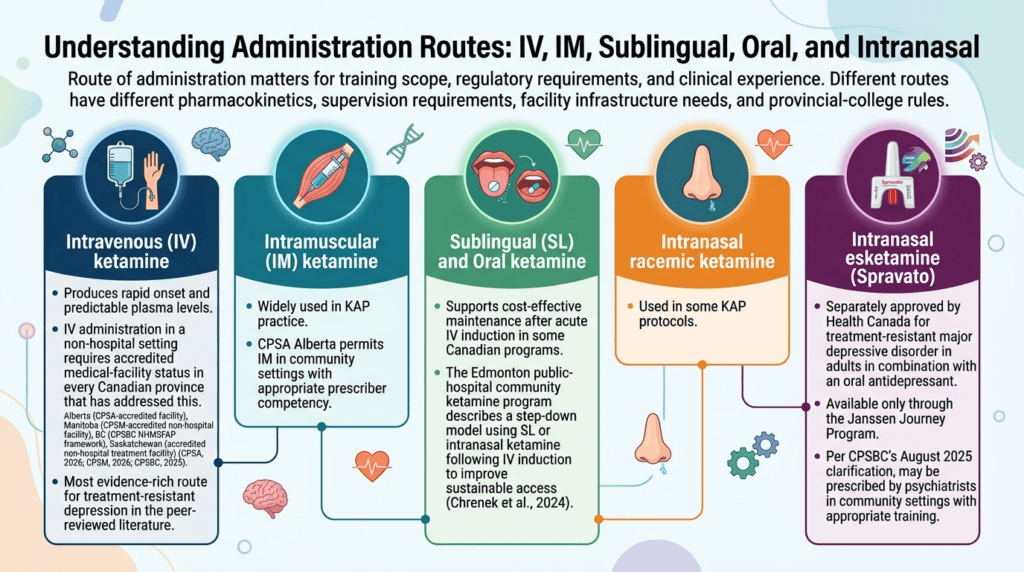
Understanding Administration Routes: IV, IM, Sublingual, Oral, and Intranasal
Route of administration matters for training scope, regulatory requirements, and clinical experience. Different routes have different pharmacokinetics, supervision requirements, facility infrastructure needs, and provincial-college rules.
Intravenous (IV) ketamine produces rapid onset and predictable plasma levels. IV administration in a non-hospital setting requires accredited medical-facility status in every Canadian province that has addressed this — Alberta (CPSA-accredited facility), Manitoba (CPSM-accredited non-hospital facility), BC (CPSBC NHMSFAP framework), Saskatchewan (accredited non-hospital treatment facility) (CPSA, 2026; CPSM, 2026; CPSBC, 2025). IV is the most evidence-rich route for treatment-resistant depression in the peer-reviewed literature.
Intramuscular (IM) ketamine is widely used in KAP practice. CPSA Alberta permits IM in community settings with appropriate prescriber competency.
Sublingual (SL) and oral ketamine support cost-effective maintenance after acute IV induction in some Canadian programs. The Edmonton public-hospital community ketamine program describes a step-down model using SL or intranasal ketamine following IV induction to improve sustainable access (Chrenek et al., 2024).
Intranasal racemic ketamine is used in some KAP protocols. Intranasal esketamine (Spravato) is separately approved by Health Canada for treatment-resistant major depressive disorder in adults in combination with an oral antidepressant. Spravato is available only through the Janssen Journey Program and, per CPSBC’s August 2025 clarification, may be prescribed by psychiatrists in community settings with appropriate training.
ATMA CENA’s Applied Clinical Practice and Prescribing & Oversight courses include route-specific protocols. The optional KAT Immersive Experience provides in-person practicum exposure.
Wondering if this is right for you?
Our clinical team can walk you through your options — no referral needed to start.
What KAT Training Covers: Core Curriculum Components
A comprehensive KAT curriculum covers screening and contraindication assessment, preparation psychotherapy, dosing-day session structure and facilitation, vital-sign monitoring and adverse-event response, integration psychotherapy, ethics and informed consent, documentation, the Canadian regulatory framework, and post-treatment continuity-of-care.
The first published competency framework for psychedelic therapist training identifies six core competencies relevant to KAT clinicians: empathetic abiding presence, trust enhancement, spiritual intelligence, knowledge of physical and psychological effects, self-awareness and ethical integrity, and proficiency in complementary techniques (Phelps, 2017). These layer on top of the clinician’s existing licensure rather than replacing core therapy skills.
ATMA CENA’s KAT-relevant courses:
| Course | Hours | CE Credits | Tuition (CAD) | Format |
|---|---|---|---|---|
| PAT Foundations | 14 hrs | 14 | $800 | Online (async) |
| Applied Clinical Practice in Psychedelic Therapy | 46 hrs | 46 | $4,200 | Online + practicum |
| Prescribing & Oversight in PAT | 40 hrs | 40 | $4,000 | Hybrid |
| Advanced Safety & Support Practices in PAT | 38 hrs | 38 | $3,500 | Hybrid |
| Supervised Learning Lab | 8 hrs | 8 | $1,000 | Small-group cohort (live) |
| KAT Immersive Experience (optional) | 3 days | Pending CE approval | $2,400 | In-person, Calgary only |
Payment plans available: 2-month and 3-month options.
Experiential Training and Live Supervision
Experiential training and live supervision are the components of KAT preparation that didactic study cannot replace. Health Canada’s December 2022 expectations for clinical trials state that during the dosing phase a minimum of two therapists must be present and that any unlicensed members of the therapy team must work under direct supervision of a licensed therapist (Health Canada, 2022).
ATMA CENA’s training combines online didactic delivery, the Supervised Learning Lab for small-group live skills practice, and the optional in-person KAT Immersive Experience for hands-on exposure to the full arc of a KAT session.
Personal experiential exposure to non-ordinary states is an active discussion in the field. A peer-reviewed review in Psychedelic Medicine argues that firsthand subjective experience of PAT is a crucial training element for practitioners (Dames et al., 2024). Health Canada SAP protocols do not mandate personal psychedelic experience as a training prerequisite.

Prescriber Track: Training for Physicians and Nurse Practitioners
Physicians and nurse practitioners with controlled-substance prescribing authority hold the unique professional capacity to prescribe ketamine, lead medical screening, and serve as medical director for KAT delivery. ATMA CENA’s Prescriber Pathway is designed for this audience.
Provincial-college guidance is the operative training framework for prescribers:
Alberta (CPSA): PAT must be provided within a CPSA-accredited medical facility by a psychiatrist or a physician in consultation with a psychiatrist (CPSA, 2026).
Manitoba (CPSM): Emphasizes prescriber competency, DPIN review, and accredited facilities for IV administration (CPSM, 2026).
British Columbia (CPSBC): Interim Guidance (Version 1.3, August 2025) covers non-IV routes in community settings; informed consent for off-label use is emphasized (CPSBC, 2025).
Ontario (CPSO): No ketamine-specific policy published. Off-label use falls under the general Prescribing Drugs policy and the Complementary and Alternative Medicine policy. Prescribers must demonstrate adequate knowledge, skill, and judgment.
Quebec (INESSS): May 2025 clinical opinion supports parenteral KAT within a defined framework (INESSS, 2025).
Safety, Screening, and Risk Management in KAT Practice
Ketamine has a well-documented safety profile in supervised clinical contexts. A systematic review of 93 ketamine trials (3,756 participants) found an incidence of serious medical adverse events of approximately 0.1% and zero serious cardiac or cerebrovascular events under screened conditions (Hovda et al., 2024). Cardiovascular stimulation, including transient hypertension and tachycardia, is common during dosing and resolves without intervention in most cases. Dissociative reactions are the most prominent acute adverse effect and typically resolve within 1.5 hours after the dose.
Long-term bladder safety (ketamine-associated uropathy) is documented predominantly in heavy recreational users. A meta-analysis of 45 articles (4,921 patients) found that hydronephrosis occurred in approximately 30% of cases, almost exclusively in chronic high-dose recreational users (Chan et al., 2022). Evidence for clinically dosed therapeutic ketamine causing cystitis is limited to rare case reports.
Training programs must teach screening and contraindication assessment for cardiovascular risk (uncontrolled hypertension, unstable angina, raised intracranial pressure, recent myocardial infarction); psychiatric risks (active psychosis, mania, certain dissociative disorders); pregnancy; and concurrent medications (notably MAOIs, certain CYP3A4 interactions).
Provincial Regulatory Context for KAT Training
No single national framework governs KAT in Canada. Each province’s physician college sets the rules for off-label ketamine prescribing, and the rules differ materially. The summary below reflects the regulatory landscape as of May 2026.
| Province | College | Framework | Last updated |
|---|---|---|---|
| Alberta | CPSA | March 2026 guidance; IV requires CPSA-accredited facility; PAPT requires provincial licence + CPSA accreditation; psychiatrist or physician-in-consultation | March 2026 |
| British Columbia | CPSBC | Interim Guidance v1.3 for IM/oral/SL/IN; IV separately addressed under NHMSFAP | August 2025 |
| Manitoba | CPSM | January 2026 guidance; DPIN review; accredited facility for IV | January 2026 |
| Ontario | CPSO | No ketamine-specific policy; falls under general CAM and Prescribing Drugs policies | No KAT-specific date |
| Quebec | CMQ / INESSS | INESSS May 2025 opinion supports parenteral KAP for TRD within a framework | May 2025 |
| Saskatchewan | CPSS | January 2021 position; parenteral routes require accredited non-hospital treatment facility | January 2021 |
Important notice: Racemic ketamine is approved by Health Canada as an anaesthetic. Its use for psychiatric indications is off-label. Off-label prescribing does not require Health Canada’s Special Access Program. Esketamine (Spravato) is separately approved by Health Canada for treatment-resistant MDD in adults, in combination with an oral antidepressant, available only through the Janssen Journey Program. Provincial standards for KAT are evolving — verify current requirements with your own regulatory college before practice.
Already trained and ready to bring KAT into your practice? Explore the CoCare program for clinical protocols, operational systems, and access to a network of trained clinicians.

CE Credits, Accreditation, and Professional Recognition
ATMA CENA’s confirmed CE credit values per course:
- PAT Foundations: 14 CE credits
- Applied Clinical Practice: 46 CE credits
- Prescribing & Oversight: 40 CE credits
- Advanced Safety & Support Practices: 38 CE credits
- Supervised Learning Lab: 8 CE credits
- KAT Immersive Experience: CE approval pending
For CE credit applicability to your specific registration, talk to an advisor.
Wondering if this is right for you?
Our clinical team can walk you through your options — no referral needed to start.
After Training: Integrating KAT Into Your Canadian Practice
Completing training is the first step toward delivering KAT in clinical practice. The next steps depend on the clinician’s professional registration, the provincial regulatory rules, and the practice setting.
For clinicians working independently, the considerations include securing prescriber partnership (for non-prescribers), establishing facility compliance for the routes being delivered, implementing screening and intake protocols, documenting informed consent for off-label use, securing professional liability coverage that explicitly includes KAT, and arranging ongoing supervision for the first cohort of cases.
ATMA CENA’s CoCare program provides clinical protocols, operational systems, and access to a network of trained clinicians. CoCare requires completion of an ATMA CENA training pathway (Clinical or Prescriber) and is the structured route for integrating KAT into an existing or new practice within ATMA CENA’s network.
ATMA CENA’s clinics include the corporate locations in Edmonton and Calgary plus member clinics in Hamilton, Kitchener-Waterloo, London, Mississauga, Montreal, North Bay, Oakville, Sarnia, Saskatoon, Vaughan, Windsor, and Winnipeg.
Frequently Asked Questions
Is ketamine therapy training legal in Canada?
Yes. Training to deliver supervised ketamine-assisted psychotherapy is legal in Canada. Ketamine is a Health Canada-approved anaesthetic; its use for psychiatric indications is off-label and regulated by provincial physician colleges rather than by Health Canada directly.
Do I need to be a physician to train in KAT?
No. Training is open to a range of registered mental-health professionals including registered psychotherapists (Ontario), permit-holding psychotherapists (Quebec), registered counsellors, registered psychologists, registered nurses, and registered social workers. Only physicians and nurse practitioners can prescribe and administer the medicine itself; non-prescribers serve on multidisciplinary teams under prescriber oversight.
How long does KAT training take?
Time-to-completion varies by pathway and prior experience. The Foundations course is 14 hours of didactic content. Applied Clinical Practice (Clinical pathway) is 46 hours. Prescribing & Oversight (Prescriber pathway) is 40 hours. Supervised practicum and the optional KAT Immersive Experience add additional time. Many clinicians complete a full pathway over 6 to 18 months while continuing active practice.
What CE credits does ATMA CENA’s KAT training carry?
Foundations: 14 credits; Applied Clinical Practice: 46 credits; Prescribing & Oversight: 40 credits; Advanced Safety & Support: 38 credits; Supervised Learning Lab: 8 credits; KAT Immersive: pending CE approval. For applicability to your specific registration, talk to an advisor.
Does ketamine require a Special Access Program (SAP) application?
No. Ketamine is an approved drug in Canada with an existing Drug Identification Number. Off-label psychiatric use does not require SAP. SAP applies only to drugs not marketed in Canada — for the psychedelic field, that means psilocybin and MDMA require SAP, but ketamine does not.
Can registered counsellors deliver ketamine therapy?
Counsellors cannot prescribe, dispense, or administer ketamine. They can deliver the psychotherapy components of KAT — preparation and integration counselling, therapeutic alliance, support during dosing sessions — within a multidisciplinary team led by a prescribing physician or nurse practitioner.
What does experiential training in KAT involve?
Experiential training typically includes observation of a KAT session and co-facilitation under direct supervision. ATMA CENA’s KAT Immersive Experience is a 3-day in-person practicum in Calgary offered to clinicians who choose to add it to their pathway.
How does KAT differ from ketamine infusion alone?
KAT integrates structured psychotherapy with the medicine across three phases: preparation, dosing-day support, and integration. A peer-reviewed open-label trial found that adding 10 weeks of cognitive behavioural therapy following IV ketamine produced sustained response in 75% of ketamine responders at 8 weeks, compared with the typically transient response seen after ketamine alone (Wilkinson et al., 2017).
Compliance Disclaimer
Ketamine is approved by Health Canada as an anaesthetic. Use for depression, anxiety, PTSD, and other mental-health indications is off-label, regulated by provincial medical regulators — for example, CPSA in Alberta, CPSM in Manitoba, CPSBC in British Columbia, and CPSO in Ontario. Esketamine (Spravato) is Health Canada-approved for treatment-resistant depression in adults aged 18–64 in combination with an SSRI or SNRI, available only through the Janssen Journey Program.
Psilocybin and MDMA are restricted drugs under Canada’s Controlled Drugs and Substances Act. Patient access to psilocybin- or MDMA-assisted therapy is available only through Health Canada’s Special Access Program (SAP) on a case-by-case basis. SAP approval is not guaranteed. Completion of any training program does not constitute authorization to administer psilocybin or MDMA.
This article is educational and is not a clinical recommendation for any individual.
About the Author
Reverdi Darda, RN, BScN (Reg. #61707) is CEO & Founder of ATMA CENA and a Registered Nurse with over three decades of experience in healthcare operations, community engagement, policy development, and strategic planning. A recognized leader in mental health access, Reverdi has dedicated her career to advancing evidence-based treatment models and advocating for policy change that prioritizes effective care. She founded ATMA CENA to expand practitioner and public access to psychedelic-assisted therapy across Canada.
Medically reviewed by Jean-Jacques Lovely, RN, MN, MBA, PMP (Reg. #74334), Head of Western Operations, ATMA CENA. [Review date — PENDING]
Sources
- Health Canada. Drug Product Database — Ketamine Hydrochloride Injection USP (DIN 02246796).
- Health Canada. Drug Product Database — Spravato (DIN 98903).
- Health Canada (2022). Notice to stakeholders: Health Canada’s expectations regarding risk-management measures for clinical trials involving psychedelic-assisted psychotherapy.
- College of Physicians and Surgeons of Alberta (2026). Ketamine Prescribing, Administration and Oversight Expectations (March 2026).
- CPSA. Psychedelic-Assisted Psychotherapy Facility Accreditation.
- College of Physicians and Surgeons of Manitoba (2026). Ketamine: What Prescribers and Pharmacists Need to Know (January 2026).
- College of Physicians and Surgeons of British Columbia (2025). Interim Guidance: Ketamine Administration via Intramuscular, Oral, Sublingual, Intranasal Routes (Version 1.3, August 2025).
- CPSO. Prescribing Drugs.
- INESSS (2025). Parenteral ketamine for treatment-resistant depression in adults (May 2025).
- College of Registered Psychotherapists of Ontario. Psychedelic-Assisted Psychotherapy Resource.
- College of Alberta Psychologists (2025). Practice Guideline: Psychedelic-Assisted Psychotherapy (June 2025).
- Government of Alberta. Psychedelic Drug Treatment Service Provider Licensing.
- Kang, M.J.Y., Hawken, E. & Vazquez, G.H. (2022). The Mechanisms Behind Rapid Antidepressant Effects of Ketamine. Frontiers in Psychiatry, 13:860882.
- Dean, R.L. et al. (2021). Ketamine and other glutamate receptor modulators for depression in adults with bipolar disorder. Cochrane Database of Systematic Reviews.
- Alnefeesi, Y. et al. (2022). Real-world effectiveness of ketamine in treatment-resistant depression: A systematic review and meta-analysis. Journal of Psychiatric Research.
- Chrenek, C. et al. (2024). Use of ketamine for treatment-resistant depression: updated review and practical applications to a community ketamine program in Edmonton, Alberta, Canada. Frontiers in Psychiatry.
- Dore, J. et al. (2019). Ketamine Assisted Psychotherapy: Patient Demographics, Clinical Data and Outcomes in Three Large Practices. Journal of Psychoactive Drugs, 51(2).
- Yermus, R. et al. (2024). Ketamine-Assisted Psychotherapy in a Real-World Canadian Setting. Psychedelic Medicine, 2(2).
- Wilkinson, S.T. et al. (2017). Cognitive Behavior Therapy for the Prevention of Relapse and Recovery of Response to Intravenous Ketamine in Treatment-Resistant Depression. Psychotherapy and Psychosomatics, 86(3).
- Drozdz, S.J. et al. (2022). Ketamine Assisted Psychotherapy: A Systematic Narrative Review of the Literature. Journal of Pain Research, 15.
- Phelps, J. (2017). Developing Guidelines and Competencies for the Training of Psychedelic Therapists. Journal of Humanistic Psychology, 57(5).
- Hartogsohn, I. (2018). The Meaning-Enhancing Properties of Psychedelics. Frontiers in Neuroscience, 12:129.
- Gorman, I. et al. (2021). Psychedelic Harm Reduction and Integration: A Transtheoretical Model. Frontiers in Psychology, 12:645246.
- Brennan, W. & Belser, A.B. (2022). EMBARK: A Transdiagnostic, Trans-Drug PAP Model. Frontiers in Psychology, 13:866018.
- Popova, V. et al. (2019). Esketamine nasal spray for TRD: TRANSFORM-2 Phase 3. American Journal of Psychiatry.
- Hovda, S. et al. (2024). Ketamine safety: systematic review. Journal of Affective Disorders.
- Chan, K.W.Y. et al. (2022). Ketamine-associated uropathy meta-analysis. Hong Kong Medical Journal.
- Dames, S. et al. (2024). Firsthand experience as a training element for PAT practitioners. Psychedelic Medicine.
- Tai, S.J. et al. (2021). Development and Evaluation of a Therapist Training Program for Psilocybin Therapy for Treatment-Resistant Depression. Frontiers in Psychiatry, 12:586682.
Get trained in ketamine assisted therapy
Explore ATMA CENA locations across Canada.
- Ketamine Therapy Training Edmonton
- Ketamine Therapy Training Calgary
- Ketamine Therapy Training Hamilton
- Ketamine Therapy Training Kitchener-Waterloo
- Ketamine Therapy Training London
- Ketamine Therapy Training Mississauga
- Ketamine Therapy Training Montreal
- Ketamine Therapy Training North Bay
- Ketamine Therapy Training Sarnia
- Ketamine Therapy Training Saskatoon
- Ketamine Therapy Training Vaughan
- Ketamine Therapy Training Windsor
- Ketamine Therapy Training Winnipeg
About the author
Reverdi Darda
President & CEO ATMA CENA Psychedelic Healthcare Solutions Inc. and passionate RN who advocates for better access to mental health supports.