
Ketamine Therapy FAQs: Canadian Patient Guide (2026)
Fifteen patient-facing answers to the most common questions about ketamine therapy in Canada: what it is, who qualifies, what it costs, how it's regulated, what a session feels like, and how it compares to other options. Each answer is current as of May 2026. Confirm details with your provincial health regulator and your prescribing physician for your specific situation.
Medically reviewed by Jacque Lovely, RN, MN, MBA, PMP, Reg #74334 on 2026-05-27.
If you have a question not answered below, book a free 15-minute information call and ATMA CENA's clinical team will answer your questions directly.
Key takeaways
- Ketamine is legal for medical use in Canada; psychiatric use is off-label, regulated by provincial physician colleges.
- Spravato (esketamine nasal spray) is Health Canada-approved for treatment-resistant MDD specifically; racemic ketamine is not approved for any psychiatric indication.
- Antidepressant effects can emerge within hours to days, compared to weeks for SSRIs.
- Most acute treatment courses involve six sessions over two to three weeks.
- At ATMA CENA, ketamine-assisted therapy starts at $1,590 for an initial treatment plus $800 per additional medicine session, with discounted multi-session packages; cost and insurance pathways are linked below.
- Active psychosis, uncontrolled severe hypertension, and current pregnancy are among the absolute contraindications.
Is ketamine therapy legal in Canada?
Yes. Ketamine is a Schedule I controlled substance under the Controlled Drugs and Substances Act, but that classification allows medical use when prescribed by a physician or nurse practitioner. Health Canada approved ketamine as a general anaesthetic; its use for depression, PTSD, anxiety, and other psychiatric indications is off-label, a legal and common practice in Canadian medicine. Provincial physician colleges (CPSA in Alberta, CPSM in Manitoba, CPSO in Ontario, CPSBC in British Columbia, and others) set the facility and practice standards for how and where it can be administered.
Is ketamine therapy safe?
At sub-anaesthetic doses with proper patient screening and supervised administration, ketamine has a well-established short-term safety profile (Wan et al., 2015). Common short-term effects include dissociation, mild nausea, transient blood pressure elevation, dizziness, and headache. Serious adverse events are uncommon with appropriate screening. Sessions are conducted with vital-sign monitoring throughout. Ketamine cystitis is documented in long-term high-dose recreational users; at therapeutic doses with proper monitoring, the risk is much lower. Long-term maintenance patients receive baseline and ongoing liver-function monitoring.
How does ketamine therapy work?
Ketamine blocks NMDA receptors on inhibitory interneurons, triggering a downstream surge of glutamate, AMPA receptor activation, and BDNF release. This stimulates synaptogenesis (the formation of new neural connections) within 24 to 72 hours of a dose (Kang et al., 2022). Where SSRIs gradually adjust serotonin signalling over weeks, ketamine acts on the glutamate system directly. Antidepressant effects can emerge within hours to days of a single dose (Lullau et al., 2023). In the ELEKT-D trial (Anand et al., 2023), intravenous ketamine demonstrated non-inferiority to electroconvulsive therapy for non-psychotic treatment-resistant depression (PMID 37224232).
Does ketamine therapy get you high?
Ketamine produces a dissociative altered state at therapeutic doses, but that phrase carries recreational connotations that do not fit the clinical context. Doses are calibrated for therapeutic effect, not euphoria; the setting is supervised; the goal is psychological processing. The dissociative experience resolves within hours, and patients return to ordinary cognition before leaving the clinic. See Does Ketamine Therapy Get You High? for the full experience breakdown.
What conditions does ketamine treat?
The most established indication is treatment-resistant major depressive disorder, where CANMAT 2021 places racemic ketamine as a third-line treatment after at least two adequate antidepressant trials (Swainson et al., 2021). Other indications with randomised trial support include PTSD (Feder et al., 2014; Feder et al., 2021), treatment-refractory anxiety (Glue et al., 2017; Whittaker et al., 2021, PMID 34925757), OCD (Rodriguez et al., 2013), and chronic pain including CRPS and refractory neuropathic pain (Niesters et al., 2014). Specific eligibility for each indication is determined at clinical assessment.
What is the difference between ketamine and Spravato?
Spravato (esketamine) is the S-enantiomer of ketamine, delivered as a nasal spray and Health Canada-approved since May 2020 for treatment-resistant MDD in adults who have not responded to at least two antidepressant courses, in combination with an oral SSRI or SNRI (Health Canada DPD). It must be administered in a certified clinical setting with mandatory two-hour post-dose monitoring. ATMA CENA is certified to provide Spravato. Racemic ketamine is the off-label form with the larger psychiatric evidence base, given by other routes. Note: a separate indication for MDD with acute suicidal ideation exists under the US FDA but has not been confirmed as an approved Health Canada indication as of 2026. Do not conflate the two regulatory frameworks. See What Is Ketamine Therapy? for the full modality breakdown.
What are the different ways ketamine can be given?
Ketamine can be given by several clinical routes: intravenous (IV) infusion (approximately 100% bioavailability and the most studied), intramuscular (IM) injection, intranasal spray, sublingual lozenge, and oral. IV and IM have the most robust psychiatric trial data, and Spravato (intranasal esketamine) is the only ketamine-class drug with Health Canada psychiatric approval. Provincial regulations govern which routes require facility accreditation and where they may be administered, so check the current guidance from your provincial college. ATMA CENA offers intranasal ketamine (both Spravato and compounded intranasal), intramuscular, and oral routes at its corporate clinics. It does not provide IV ketamine.
How many sessions are needed?
Most acute protocols involve around six sessions over two to three weeks, and the average ketamine-assisted therapy course at ATMA CENA runs four to eight medicine sessions depending on individual response. Spravato has a defined induction schedule of twice-weekly for four weeks, followed by weekly for four weeks, then maintenance based on clinical response. After the acute phase, many patients return for periodic maintenance. The right number of sessions depends on individual response, durability, and the prescribing physician's clinical judgement.
How fast does ketamine work?
Faster than conventional antidepressants. Ketamine can produce antidepressant effects within hours to days, with significant improvement reported within 24 hours in multiple randomised trials. SSRIs and SNRIs typically require four to six weeks before clinical benefit appears. This speed of onset is one reason ketamine is used for patients whose depression has not responded to standard antidepressants (Swainson et al., 2021).
Who qualifies for ketamine therapy?
Adults 18 or older with a diagnosis of TRD, PTSD, treatment-refractory anxiety, OCD, or chronic pain who are medically stable, able to provide informed consent, and willing to engage in preparation and integration sessions. See How to Qualify for Ketamine Therapy in Canada for the full eligibility discussion. A clinical assessment confirms individual fit.
Who cannot have ketamine therapy?
Absolute contraindications include active psychosis or a schizophrenia spectrum disorder, uncontrolled severe hypertension, severe cardiovascular disease, elevated intracranial pressure, current pregnancy, known hypersensitivity to ketamine, an active manic episode, and active ketamine use disorder. Relative contraindications include a history of other substance use disorder, severe personality disorder with marked instability, recent stroke, untreated severe sleep apnea, concurrent MAOIs, and high-dose benzodiazepines. High-dose benzodiazepines (above approximately 8 mg diazepam-equivalent daily) have been shown to attenuate ketamine's antidepressant effect (Andrashko et al., 2020). Eligibility and any contraindications are confirmed at clinical assessment.
Is ketamine addictive?
Dependency risk at therapeutic doses in supervised clinical contexts is low. Higher dependency risk is associated with frequent unsupervised recreational use at higher doses. Active ketamine use disorder is an absolute contraindication for ketamine therapy. CANMAT 2021 notes that misuse risk should be assessed but considers it low in well-screened patients on standard protocols (Swainson et al., 2021).
What is a ketamine session like?
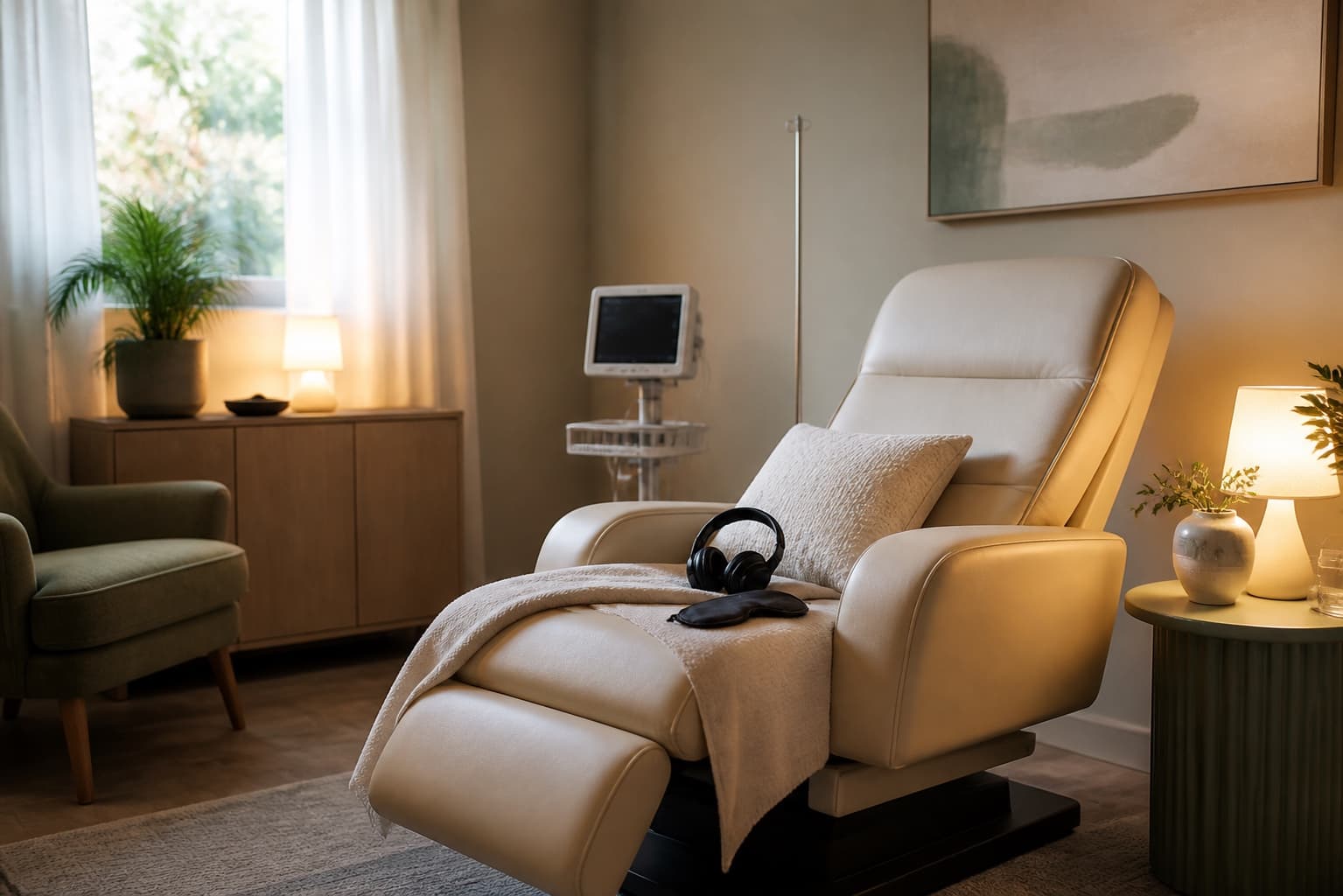
Patients typically recline with eye shades and music during the dosing window (about 45 to 90 minutes). Commonly described experiences include altered time perception, a floating or dreamlike quality, mild visual or auditory shifts, an emotional softening, and a sense of distance from habitual thought patterns (van Schalkwyk et al., 2018). A clinician or therapist remains present throughout. Patients cannot drive for at least 24 hours after a session. Full session time including monitoring is around 90 to 120 minutes; Spravato requires a minimum two-hour observation per Health Canada label.
How much does ketamine therapy cost?
At ATMA CENA, ketamine-assisted therapy is $1,590 for an initial treatment and $800 for each additional medicine session, with discounted multi-session packages ranging from $2,390 for two treatments up to $6,500 for eight. A $300 non-refundable deposit begins intake and is applied to your treatment. Pricing is the same for both forms of the therapy (a low dose for introspection, or a lower dose used during therapy) and is inclusive of clinical assessment and prescription, preparation therapy, intention-setting therapy, the medicine session, integration therapy, and follow-up care. Fees at other providers vary, so contact each clinic for current rates. See Ketamine Therapy Cost in Canada for the full breakdown.
Does insurance cover ketamine therapy?
Provincial public health plans generally do not cover ketamine for psychiatric indications, though a small number of publicly funded hospital programs in some provinces offer it. For private insurance, Spravato is the form most likely to be covered, typically with prior authorisation for documented TRD. Some private insurers have begun to cover psychedelic-assisted therapy, including ketamine-assisted therapy; coverage terms vary, so confirm current details with your insurer. Workers' compensation boards may cover compensable injury cases on applicable formularies, and Veterans Affairs Canada considers ketamine on a case-by-case basis for service-related conditions. Physician consultation is generally covered as a standard medical visit in most provinces. See Insurance Coverage for Ketamine Therapy for the full coverage landscape.
Book a free 15-minute information call to discuss your specific situation with ATMA CENA's clinical team.
Compliance disclaimer
Ketamine is approved by Health Canada as a general anaesthetic. Use for depression, PTSD, anxiety, OCD, and other mental-health indications is off-label. Off-label prescribing is legal and regulated by provincial colleges of physicians and surgeons (CPSA in Alberta, CPSM in Manitoba, CPSO in Ontario, CPSBC in British Columbia, INESSS framework in Quebec). Esketamine (Spravato) is Health Canada-approved for treatment-resistant major depressive disorder in adults who have not responded to at least two adequate antidepressant courses, in combination with an oral SSRI or SNRI; it is not approved in Canada for MDD with acute suicidal ideation (a US FDA indication only). Nothing in this article constitutes a clinical recommendation for a specific individual. Clinical decisions belong with a qualified prescribing physician.
About the author
Reverdi Darda, RN, BScN, Reg #61707 | CEO & Founder, ATMA CENA
Reverdi Darda, RN is CEO & Founder of ATMA CENA and a Registered Nurse with over three decades of experience in healthcare operations, community engagement, policy development, and strategic planning. A recognized leader in mental health access, Reverdi has dedicated her career to advancing evidence-based treatment models and advocating for policy change that prioritizes effective care. She founded ATMA CENA to expand practitioner and public access to psychedelic-assisted therapy across Canada.
Sources
- Wan LB, Levitch CF, Perez AM, et al. (2015). Ketamine safety and tolerability in clinical trials for treatment-resistant depression. J Clin Psychiatry. PMID: 25271445. https://pubmed.ncbi.nlm.nih.gov/25271445/
- Kang MJY, et al. (2022). Ketamine antidepressant mechanisms: systematic review. Front Psychiatry. PMC: 9082546. https://pmc.ncbi.nlm.nih.gov/articles/PMC9082546/
- Lullau APF, et al. (2023). Antidepressant effect onset of ketamine. Front Neurosci. https://www.frontiersin.org/journals/neuroscience/articles/10.3389/fnins.2023.1223145/full
- Anand A, et al. (2023). Ketamine vs electroconvulsive therapy in treatment-resistant depression (ELEKT-D). N Engl J Med. 388(25):2315-2325. PMID: 37224232. https://pubmed.ncbi.nlm.nih.gov/37224232/
- Swainson J, et al. (2021). CANMAT recommendations for racemic ketamine in treatment-resistant depression. Can J Psychiatry. PMID: 33174760. https://pubmed.ncbi.nlm.nih.gov/33174760/
- Feder A, et al. (2014). Efficacy of IV ketamine for treatment of chronic posttraumatic stress disorder. JAMA Psychiatry. PMID: 24740528. https://pubmed.ncbi.nlm.nih.gov/24740528/
- Feder A, et al. (2021). Efficacy of intravenous ketamine for treatment of chronic posttraumatic stress disorder. Am J Psychiatry. 178(2):193-202. PMID: 33397139. https://pubmed.ncbi.nlm.nih.gov/33397139/
- Glue P, et al. (2017). Dose-related effects of adjunct ketamine in treatment-refractory anxiety disorders. J Psychopharmacol. PMID: 28441895. https://pubmed.ncbi.nlm.nih.gov/28441895/
- Whittaker E, et al. (2021). Ketamine for treating social anxiety disorder and treatment-resistant anxiety: systematic review and meta-analysis. Ther Adv Psychopharmacol. PMID: 34925757. https://pubmed.ncbi.nlm.nih.gov/34925757/
- Rodriguez CI, et al. (2013). Randomized controlled crossover trial of ketamine in OCD. Neuropsychopharmacology. PMID: 23145663. https://pubmed.ncbi.nlm.nih.gov/23145663/
- Niesters M, et al. (2014). Ketamine for chronic pain. Br J Clin Pharmacol. PMID: 24419423. https://pubmed.ncbi.nlm.nih.gov/24419423/
- Andrashko V, et al. (2020). The antidepressant effect of ketamine is dampened by concomitant benzodiazepine medication. Front Psychiatry. 11:844. PMID: 33005153. https://pubmed.ncbi.nlm.nih.gov/33005153/
- van Schalkwyk GI, et al. (2018). Acute psychoactive effects of intravenous ketamine. J Affect Disord. PMID: 29045915. https://pubmed.ncbi.nlm.nih.gov/29045915/
- Health Canada. Spravato (esketamine) Notice of Compliance: https://health-products.canada.ca/dpd-bdpp/info?lang=eng&code=98903
- INESSS (2025). Parenteral ketamine for treatment-resistant depression in adults: clinical relevance and framework. https://www.inesss.qc.ca/
Find care near you
Explore ATMA CENA locations across Canada.
- Ketamine Therapy Edmonton
- Ketamine Therapy Calgary
- Ketamine Therapy Hamilton
- Ketamine Therapy Kitchener-Waterloo
- Ketamine Therapy London
- Ketamine Therapy Mississauga
- Ketamine Therapy Montreal
- Ketamine Therapy North Bay
- Ketamine Therapy Sarnia
- Ketamine Therapy Saskatoon
- Ketamine Therapy Vaughan
- Ketamine Therapy Windsor
- Ketamine Therapy Winnipeg