
Psychedelic Therapy Training for Physicians in Canada (2026 Guide)

President & CEO ATMA CENA Psychedelic Healthcare Solutions Inc. and passionate RN who advocates for better access to mental health supports.

Psychedelic-assisted therapy (PAT) training prepares licensed Canadian physicians and nurse practitioners to prescribe, oversee, and lead multidisciplinary teams delivering ketamine-assisted, psilocybin-assisted, and MDMA-assisted therapy within current Canadian regulatory frameworks. This guide covers the federal and provincial rules physicians must understand, eligibility for training, what a comprehensive PAT curriculum includes, specialty-specific considerations, RCPSC MOC and CFPC Mainpro+ credit recognition, comparison of available training programs in Canada, and how to begin.
Key takeaways
- Ketamine is a Health Canada-approved anaesthetic prescribed off-label for depression, anxiety, PTSD, and chronic pain. Spravato (intranasal esketamine) is Health Canada-approved for treatment-resistant major depressive disorder. Psilocybin and MDMA remain restricted drugs accessible only via Health Canada’s Special Access Program (SAP).
- Provincial physician colleges set the operational rules. Alberta (CPSA, March 2026), Manitoba (CPSM, January 2026), and British Columbia (CPSBC, August 2025 interim) have current published guidance. Ontario, Saskatchewan, and several Atlantic provinces have no ketamine-specific policy as of May 2026.
- SAP approval rates for psilocybin and MDMA dropped approximately 50 percent in 2025 [PsyCan 2025]. Training prepares prescribers regardless of approval rates because preparation, integration, and ketamine-assisted therapy do not depend on SAP authorization.
- RCPSC Maintenance of Certification (250 credits per 5-year cycle as of August 2024) and CFPC Mainpro+ (250 credits per 5-year cycle, 1 credit per hour as of December 2024) recognize accredited PAT-related learning.
- The MDPAC Psychotherapy Training Program (Nov 2025–Apr 2026) carries up to 65 RCPSC MOC Section 1 hours and 65 Mainpro+ credits with psychedelic-medicine content. TheraPsil’s Psilocybin Prescriber Masterclass carries 8 Mainpro+ credits.
Not sure which pathway fits your licence and province? Book a free 15-minute information call , a clinical advisor will help you identify the right starting point.
Why physicians are pursuing PAT training
Physician interest in psychedelic-assisted therapy has accelerated in Canada with the publication of Phase 3 evidence for MDMA in PTSD [Mitchell et al. 2021; Mitchell et al. 2023], Phase 2 evidence for psilocybin in treatment-resistant and major depressive disorder [Goodwin et al. 2022; Raison et al. 2023], the regulatory inclusion of psilocybin and MDMA in the Special Access Program in 2022, and the maturation of ketamine-assisted psychotherapy across Canadian community programs [Chrenek, Duong, Swainson et al. 2024].
The Canadian Network for Mood and Anxiety Treatments (CANMAT) classifies single-dose IV racemic ketamine as a Level 1 evidence, third-line treatment for treatment-resistant depression, while restricting other formulations to specialists at tertiary centres [Swainson et al. 2021]. Esketamine (Spravato) carries Health Canada approval for treatment-resistant MDD with up to 4.5 years of long-term safety data [Zaki et al. 2023]. CANMAT’s 2023 task-force recommendation on serotonergic psychedelics restricts use primarily to clinical trials and the SAP [Rosenblat et al. 2023]. Physicians training now are developing competencies that apply both within current regulatory frameworks (off-label ketamine, Spravato, SAP-eligible patients) and to anticipated future indications.

The Canadian regulatory landscape: SAP, ketamine, and what physicians can prescribe today
Canadian physicians and nurse practitioners with controlled-substance prescribing authority can prescribe ketamine off-label, prescribe Spravato (intranasal esketamine) through the Janssen Journey™ Program, and apply to Health Canada’s Special Access Program for psilocybin and MDMA on behalf of individual patients with serious or life-threatening conditions. Provincial physician colleges set the specific rules on facility accreditation, supervision, and documentation.
Federal: Health Canada SAP and the controlled-distribution regime
Psilocybin and MDMA are restricted drugs under the Food and Drug Regulations. Patient access is available only through Health Canada’s Special Access Program (SAP), a per-patient application pathway available to licensed physicians and nurse practitioners. Health Canada has named treatment-resistant major depressive disorder and end-of-life distress within scope for psilocybin, and post-traumatic stress disorder for MDMA [Health Canada 2022]. The SAP class exemption issued under section 56(1) of the Controlled Drugs and Substances Act permits hospitals, practitioners, and pharmacists to conduct SAP-authorized activities without individual exemptions.
SAP authorization is patient-specific and is not guaranteed. The Psychedelic Association of Canada documented an approximately 50 percent year-over-year decline in SAP approvals for psilocybin and MDMA through 2025, with prescribers receiving fifteen-page rejection letters and patients pursuing mandamus applications [PsyCan 2025]. A peer-reviewed policy analysis confirms physician obligations under SAP including documented diagnostic history, prior treatment failure, physician presence during the entire drug session, and mandatory adverse-event reporting to Health Canada [Richard, Garcia-Romeu & Henningfield 2025].
Spravato (esketamine) is governed differently. It is Health Canada-approved (Notice of Compliance, June 11, 2020) for treatment-resistant MDD in combination with an SSRI or SNRI. The product monograph (last updated May 23, 2025) requires that “Spravato can only be prescribed by a physician who is experienced and proficient in the management of major depressive disorder and enrolled in the Janssen Journey™ Program.” Administration must occur in a healthcare setting with at least two hours of post-dose monitoring.
Wondering if this is right for you?
Our clinical team can walk you through your options — no referral needed to start.
Provincial physician colleges: ketamine prescribing rules vary materially
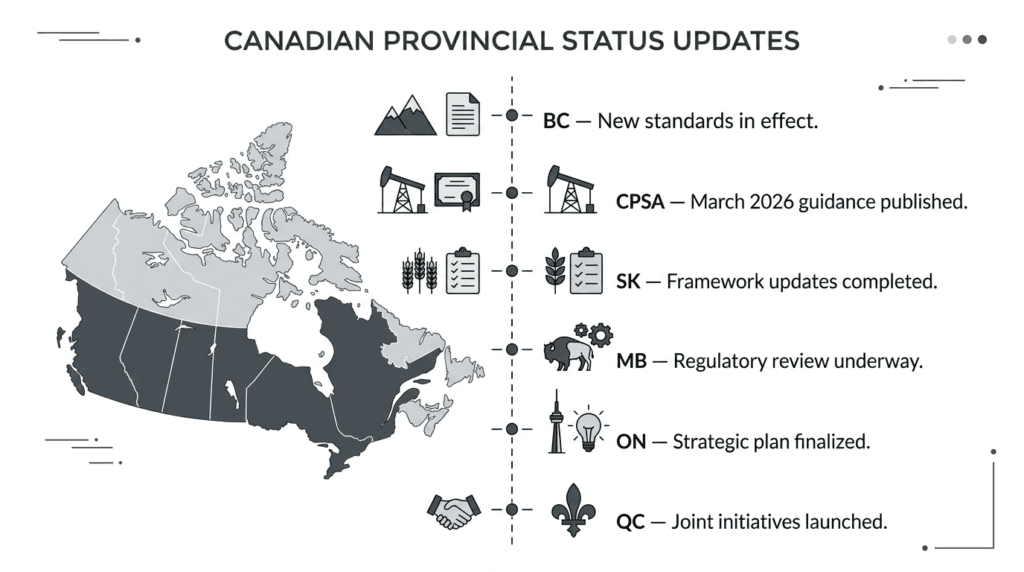
Each province’s college sets the operational rules. Provinces with published 2025–2026 ketamine guidance include:
- Alberta , CPSA issued Ketamine prescribing, administration and oversight expectations in March 2026 [CPSA 2026]. The document does not create new prescribing authority but sets expectations for off-label use and for psychedelic-assisted psychotherapy in CPSA-accredited facilities. CPSA’s facility-accreditation standards require that PAT “must be provided within a CPSA-accredited medical facility by a psychiatrist or a physician in consultation with a psychiatrist.” Effective June 2025, the Government of Alberta requires Psychedelic Drug Treatment Service Providers to be licensed; ketamine used outside the PAT context is exempt from this licensing regime.
- Manitoba , CPSM published Ketamine: What Prescribers and Pharmacists Need to Know in January 2026 [CPSM 2026]. It requires DPIN review, periodic comprehensive urine drug screening, limited dispensing intervals, and accredited non-hospital facility status for IV ketamine.
- British Columbia , CPSBC issued Interim Guidance: Ketamine Administration via IM, Oral, SL, IN Routes (Version 1.3) in August 2025 for community settings [CPSBC 2025]. IV ketamine for mood disorders is governed separately under the NHMSFAP (Non-Hospital Medical/Surgical Facilities Accreditation Program) with FRCPC anaesthesiologist involvement required.
- Ontario , CPSO has not issued a ketamine-specific or PAT-specific policy as of May 2026. Off-label use falls under the Prescribing Drugs policy (last reviewed December 2019; Advice to the Profession updated March 2026) and the Complementary and Alternative Medicine policy. Physicians must demonstrate adequate knowledge, skill, and judgment.
- Saskatchewan , CPSS issued a January 2021 position permitting off-label ketamine; parenteral routes (SQ, IM, IV) require accredited non-hospital treatment facility status.
- Quebec , INESSS issued a clinical opinion on parenteral ketamine for treatment-resistant depression in May 2025, supporting supplementary acute parenteral ketamine within coordinated care; CMQ has not published dedicated ketamine guidance.
The Canadian Medical Protective Association’s March 2026 guidance on off-label drug use names ketamine explicitly and emphasizes that “a greater degree of disclosure is generally required for off-label treatments, which includes disclosure of all associated risks” [CMPA 2026].
Regulatory notice: Racemic ketamine is approved by Health Canada as an anaesthetic (Schedule I, Controlled Drugs and Substances Act). Use for psychiatric indications is off-label. Off-label prescribing is not prohibited; provincial physician colleges set the operational rules. Esketamine (Spravato) is Health Canada-approved for treatment-resistant MDD in combination with an SSRI or SNRI and is available only through the Janssen Journey™ Program. Psilocybin and MDMA are restricted drugs accessible only through Health Canada’s Special Access Program, on a case-by-case basis. SAP authorization is not guaranteed; approval rates declined substantially in 2025. Physicians should review their provincial college’s current guidance before initiating PAT.
What psychedelic therapy training for physicians actually covers
A comprehensive physician PAT curriculum covers eight core areas: pharmacology and physiology of each medicine; screening, contraindication assessment, and patient selection; informed-consent obligations for off-label and SAP-authorized use; supervised dosing-day skills including team coordination and adverse-event response; integration psychotherapy and the prescriber’s role across phases; SAP application authorship for psilocybin and MDMA; provincial regulatory framework and facility-compliance requirements; and ongoing supervision and continuing education.
The first published competency framework for psychedelic therapist training identifies six core competencies relevant to all PAT clinicians including physicians: empathetic abiding presence, trust enhancement, spiritual intelligence, knowledge of physical and psychological effects, self-awareness and ethical integrity, and proficiency in complementary techniques [Phelps 2017]. Tai et al. (2021) evaluated a four-component psilocybin therapist training program (online learning, five-day in-person workshop, supervised research sessions, and ongoing mentoring) across 65 trainees in Canada, the United States, and Europe and found that “clinical training and engagement in participant care, under the guidance of experienced therapists, were considered the most beneficial and challenging aspects of the training” [Tai et al. 2021].
Comprehensive systematic reviews establish that “psychotherapy, provided before, during, and following ketamine sessions, can maximize and prolong benefits” across 17 studies of ketamine-assisted psychotherapy [Drozdz et al. 2022]. A real-world Canadian effectiveness study at 11 Field Trip Health clinics documented sustained large effect sizes (Cohen’s d 0.61–0.86) for KAP at 3 and 6 months in 346 patients [Yermus et al. 2024]. Training prepares physicians to deliver and supervise this combined model.
Specialty-specific considerations: psychiatrists, family physicians, and nurse practitioners
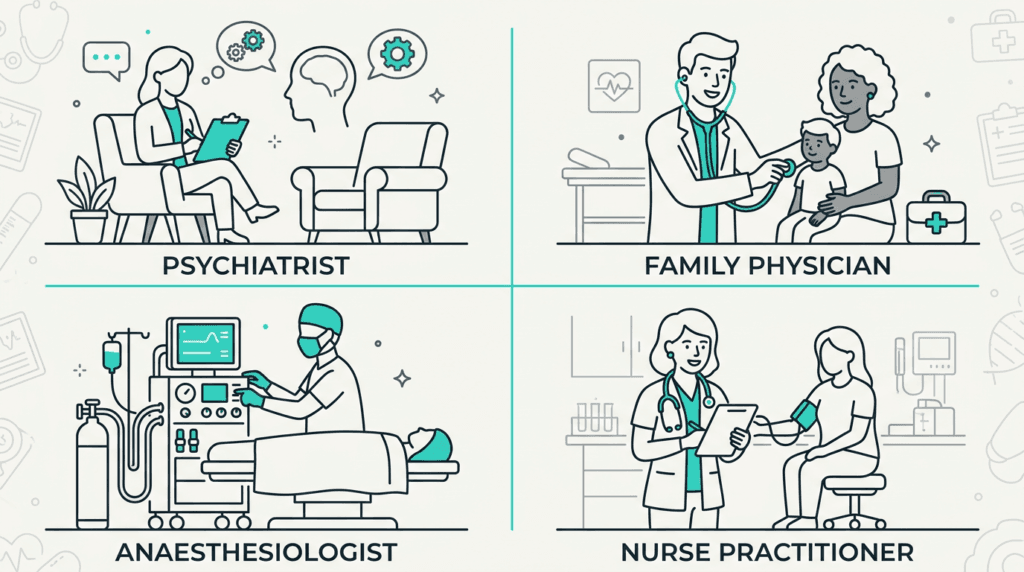
PAT scope is shaped by your specialty and provincial scope. Psychiatrists can lead Alberta’s CPSA-accredited PAPT facilities, supervise comprehensive multidisciplinary teams, and deliver the broadest range of PAT contexts. Family physicians can prescribe ketamine off-label within their scope and pursue Mainpro+ credits; in Alberta, family physicians delivering PAPT must work in consultation with a psychiatrist. Nurse practitioners with controlled-substance prescribing authority can apply through SAP and prescribe ketamine within their provincial NP scope.
| Specialty | Typical PAT roles | Notable provincial considerations |
| Psychiatrists | Medical director of PAPT facilities; SAP application authorship; clinical oversight; integration psychotherapy where the psychiatrist also delivers therapy; Spravato prescribing (community settings in BC restricted to psychiatrists per CPSBC) | Alberta: must serve as Medical Director under June 2025 PDTS licensing; CPSA-accredited facility required for PAPT |
| Family physicians | Off-label ketamine prescribing within scope; SAP application authorship; collaboration with multidisciplinary therapy teams | Alberta: PAPT in community settings requires consultation with a psychiatrist; CPSA accreditation applies |
| Emergency physicians | Acute ketamine pharmacology familiarity; rare PAT clinical role unless transitioning to outpatient psychiatric practice | Same provincial framework as other physicians |
| Anaesthesiologists (FRCPC) | Required for IV ketamine in BC NHMSFAP-accredited mood-disorder facilities; supervisory role in IV programs | BC NHMSFAP applies; Alberta IV ketamine requires CPSA-accredited facility |
| Nurse Practitioners | Off-label ketamine prescribing within provincial NP scope and CDS prescribing authority; SAP application authorship | Provincial NP regulations vary. Alberta CRNA, BC BCCNM, Ontario CNO each set CDS prescribing course requirements. NPs generally cannot administer IV ketamine independently. |
ATMA CENA’s Prescriber Pathway is designed for physicians and nurse practitioners with prescribing authority. For physicians who want to deliver therapy as well as prescribe, the Clinical Pathway covers direct-delivery competencies.
CME and MOC accreditation: Mainpro+ and RCPSC credits
Continuing-education recognition for physicians depends on the accrediting body the program targets. Two frameworks govern Canadian physician CPD:
RCPSC Maintenance of Certification (Royal College). Effective August 2024, the framework is 250 credits per 5-year cycle with a 25-credit annual minimum. Section 1 (Accredited Group Learning) and Section 2 (Self-Learning) minimums were removed. Section 3 (Assessment) requires a minimum of 25 credits per cycle including one Feedback Received activity [RCPSC 2024]. PAT-related learning qualifies under Section 1 when delivered through accredited group learning, Section 2 for self-directed reading and online modules, and Section 3 for practice audits and quality-improvement initiatives.
CFPC Mainpro+ (College of Family Physicians). Effective December 2024, all activities now earn 1 credit per hour (multiplier credits for previously enhanced activities sunset on December 31, 2025). Five-year cycle is 250 credits with at least 125 Certified credits and at least 10 Certified Assessment credits [CFPC 2024]. Annual minimum is 25 credits.
Wondering if this is right for you?
Our clinical team can walk you through your options — no referral needed to start.
Confirmed Canadian PAT-relevant accreditations as of May 2026:
| Program | Provider | RCPSC MOC | CFPC Mainpro+ | Notes |
| MDPAC Psychotherapy Training Program 2025/2026 | MDPAC via McMaster CPD | Up to 65 Section 1 hours | Up to 65 credits | Foundational psychotherapy with psychedelic-medicine content; Nov 2025–Apr 2026 |
| TheraPsil Psilocybin Prescriber Masterclass | TheraPsil | Not confirmed | 8 Mainpro+ credits | 8 hours, online, prescriber-focused SAP workflow |
| TheraPsil MDMA Prescriber Masterclass | TheraPsil | Not confirmed | Pending | On-demand format launched 2025 |
| Numinus Practitioner Certification Pathway | Numinus | Not confirmed for physicians | Not confirmed | Accredited for CPA, OPQ, CCPA, NBCC; physicians self-report |
ATMA CENA’s specific accreditation status with RCPSC and CFPC is listed on the psychedelic therapy certification in Canada page. For verification of credit applicability to your licence, see practitioner FAQs.
Comparing physician training pathways in Canada
Physicians evaluating PAT training in Canada typically choose among five approaches:
- TheraPsil Prescriber Masterclasses , 8-hour online masterclasses for psilocybin and MDMA; SAP-focused; CFPC Mainpro+ accredited (psilocybin); $1500 ($750 per masterclass).
- MDPAC Psychotherapy Training Program , foundational psychotherapy with psychedelic content; RCPSC MOC and Mainpro+ accredited; $1,750–$2,000; 5-month virtual cohort.
- ATMA CENA Prescriber Pathway, Foundations course (14 hours, $800) plus Prescribing & Oversight in Psychedelic-Assisted Therapy (40 hours, $4,000), with optional Ketamine-Assisted Therapy Immersive Experience ($2,400, 3 days in-person).
- Numinus Practitioner Certification Pathway , multi-course pathway with CPA, OPQ, CCPA accreditation; physicians may need to self-report under RCPSC/Mainpro+.
- University-affiliated programs , UHN/U of T Michener Institute Foundations of Psychedelic Psychotherapy Program; Vancouver Island University’s graduate certificate was discontinued in November 2025.
The right choice depends on the physician’s specialty, depth of intended PAT involvement, preferred CME credit framework, and whether the physician will deliver therapy or only prescribe and oversee.
ATMA CENA’s Prescriber Pathway: what to expect
ATMA CENA’s Prescriber Pathway is built around two courses plus optional in-person components.
Foundations course (prerequisite for all pathways): the 14-hour Psychedelic-Assisted Therapy Foundations covers history, neurobiology of altered states, ethics, the therapeutic frame (set, setting, support), screening principles, and the Canadian regulatory landscape.
Prescribing & Oversight in Psychedelic-Assisted Therapy (40 hours): the advanced course covers ketamine pharmacology and dosing, route-specific protocols (IV, IM, SL, oral, intranasal), cardiovascular and neurological screening, SAP application authorship for psilocybin and MDMA, multidisciplinary-team leadership, adverse-event response, and provincial regulatory compliance.
Optional Ketamine-Assisted Therapy Immersive Experience (3 days, in-person): the KAT Immersive provides hands-on practicum exposure to a full KAT session arc.
Already running a clinic and considering integrating PAT? ATMA CENA’s CoCare program is designed for clinic-owning physicians who want to bring psychedelic-assisted therapy into an existing practice with established clinical protocols and operational systems.
Wondering if this is right for you?
Our clinical team can walk you through your options — no referral needed to start.
Clinical safety: screening, contraindications, and adverse-event management
Sub-anaesthetic ketamine has a well-documented safety profile in supervised clinical settings. A systematic review of 93 clinical trials (3,756 patients) found a serious medical adverse-event incidence of approximately 0.1 percent with no cardiac deaths under screened conditions [Hovda et al. 2024]. The authors note that “with basic medical screening there is a very low incidence of MSAEs including adverse cardiac or cerebrovascular events.”
Cardiovascular contraindications (uncontrolled hypertension, unstable angina, recent myocardial infarction, raised intracranial pressure), psychiatric contraindications (active psychosis, mania, certain dissociative disorders), pregnancy, and concurrent medications (notably MAOIs and certain CYP3A4 interactions) are standard exclusions. Validated assessment tools , PHQ-9 for depression, CAPS-5 or PCL-5 for PTSD, validated dissociation scales , should be applied consistently. Long-term bladder safety (ketamine-associated uropathy) is documented predominantly in heavy recreational users [Chan et al. 2022]; evidence for clinically dosed therapeutic ketamine is limited to rare case reports.
Esketamine (Spravato) requires at least two hours of post-dose monitoring per the product monograph, with vital-sign assessment and dissociation evaluation. SUSTAIN-3 long-term data over 4.5 years (n=1,148) found no new safety signals [Zaki et al. 2023].
Health Canada’s December 2022 expectations for clinical trials state that “during the phase in which the drug is being administered to the participants, there should be a minimum of two therapists present” and that “any unlicensed members of the therapy team should be under the direct supervision of a licensed therapist” [Health Canada 2022]. While directed at clinical trials, the expectations articulate Health Canada’s view of evidence-based safe practice.
How to get started: application, prerequisites, and next steps
- Confirm provincial registration in good standing. PAT training builds on top of existing licensure; it does not confer prescribing authority where none exists.
- Complete the Foundations course. The Psychedelic-Assisted Therapy Foundations (14 hours, $800) is the prerequisite for all pathways.
- Choose your specialty-aligned pathway. Prescriber Pathway for physicians and NPs prescribing and overseeing PAT; Clinical Pathway for physicians who also deliver therapy; the ATMA CENA hub at /psychedelic-therapy-training/ compares all three.
- Plan for supervised practicum. The optional KAT Immersive Experience provides in-person exposure; ongoing supervision after independent practice begins is the professional standard.
- Maintain CE/CPD currency. Track RCPSC MOC and Mainpro+ credits; review provincial-college guidance updates; reference ATMA CENA’s licensing-and-accreditation page for institutional credentials.
For physicians at the start of the decision: book a free 15-minute information call with a clinical advisor to evaluate fit before committing to a pathway.
Frequently asked questions
Can family physicians prescribe ketamine for depression in Canada?
Yes, with provincial-college conditions. Off-label ketamine prescribing is permitted across Canadian provinces. In Alberta, community-setting psychedelic-assisted psychotherapy with ketamine requires the prescribing physician to operate in a CPSA-accredited facility, and a family physician must work in consultation with a psychiatrist. Other provinces have different rules; CPSM Manitoba and CPSBC BC have current published guidance. Ontario’s CPSO has no ketamine-specific policy; off-label use falls under general prescribing standards.
Do I need to be a psychiatrist to lead a PAT clinic in Alberta?
In Alberta, a CPSA-accredited PAPT facility must be led by a psychiatrist, or by a physician operating in consultation with a psychiatrist [CPSA 2026]. The Government of Alberta’s June 2025 Psychedelic Drug Treatment Services Provider licensing requires that the Medical Director be a psychiatrist. Other provinces have not implemented equivalent requirements as of May 2026.
How does an MD apply for psilocybin or MDMA via the Special Access Program?
A licensed physician (or nurse practitioner with controlled-substance prescribing authority) submits a patient-specific SAP application to Health Canada describing the patient’s diagnosis, prior treatment failure, and the proposed protocol. Health Canada reviews case-by-case. The physician must remain present (or delegate to a healthcare professional) during the entire drug session and submit mandatory follow-up adverse-event reporting. Approval is not guaranteed; SAP approval rates dropped approximately 50 percent through 2025 [PsyCan 2025].
Are ATMA CENA’s courses recognized for RCPSC MOC and CFPC Mainpro+ credits?
The psychedelic therapy certification in Canada page maintains current accreditation IDs. For comparison, MDPAC’s Psychotherapy Training Program offers up to 65 RCPSC MOC Section 1 hours and 65 Mainpro+ credits, and TheraPsil’s Psilocybin Prescriber Masterclass offers 8 Mainpro+ credits.
Can nurse practitioners prescribe ketamine and apply through SAP?
NPs with controlled-substance prescribing authority can prescribe ketamine off-label within their provincial scope and apply to SAP for psilocybin or MDMA on behalf of patients. CDS prescribing course completion is required in all provinces before NPs may prescribe controlled substances. NPs generally cannot administer IV ketamine independently; non-parenteral routes (oral, sublingual, intranasal) are more accessible within NP scope. Provincial regulations vary , confirm with your NP regulator (CRNA Alberta, BCCNM BC, CNO Ontario, CRNM Manitoba, OIIQ Quebec, NSCN Nova Scotia).
What is the difference between Spravato and racemic ketamine for prescribing physicians?
Spravato (intranasal esketamine) is Health Canada-approved for treatment-resistant MDD in combination with an SSRI or SNRI and is dispensed only through the Janssen Journey™ controlled-distribution program. Physicians must enrol in the program before prescribing. Racemic ketamine (the form generally used in KAP) is approved as an anaesthetic; psychiatric use is off-label. Provincial-college rules apply differently to each.
How long does the Prescriber Pathway take?
The pathway combines the 14-hour Foundations course and the 40-hour Prescribing & Oversight course, plus the optional 3-day KAT Immersive Experience. Most physicians complete the pathway over 6 to 12 months while continuing active practice. ### Will completing training authorize me to deliver psilocybin or MDMA therapy?
No. Completing any training program does not authorize a prescriber to administer psilocybin or MDMA. Authorization for those substances is patient-specific and granted by Health Canada through the SAP. Training prepares prescribers to author SAP applications, deliver supervised therapy under SAP authorization, and conduct patient screening and integration regardless of whether SAP authorization is granted in any given case.
How does ATMA CENA’s pathway compare to MAPS or US-based programs?
ATMA CENA’s Prescriber Pathway is anchored in Canadian regulatory frameworks (CPSA, CPSM, CPSBC, CPSO, INESSS) and SAP application practice. MAPS-affiliated training is internationally recognized but is centred on MDMA-assisted therapy in the US regulatory context, which differs materially from Canada. Programs like CIIS (US) and Polaris Insight Center (US) target US licensure and may require Canadian physicians to self-report under RCPSC MOC. The Comparing Physician Training Pathways section above outlines the trade-offs.
What is CoCare and how does it differ from training?
CoCare is ATMA CENA’s program for clinic-owning physicians and clinics that want to integrate psychedelic-assisted therapy into an existing practice. It is separate from training: it provides clinical protocols, operational systems, medical-director oversight where applicable, and access to the network of trained clinicians. Training prepares the individual practitioner; CoCare prepares the practice. See /cocare/ for the full program description.
About the Author
Reverdi Darda, RN, BScN (Reg. #61707) is CEO & Founder of ATMA CENA and a Registered Nurse with over three decades of experience in healthcare operations, community engagement, policy development, and strategic planning. A recognized leader in mental health access, Reverdi has dedicated her career to advancing evidence-based treatment models and advocating for policy change that prioritizes effective care. She founded ATMA CENA to expand practitioner and public access to psychedelic-assisted therapy across Canada.
Medically reviewed by Jacques Lovely, RN, MN, MBA, PMP (Reg. #74334), Head of Western Operations, ATMA CENA.
Sources
- Health Canada (2022). Notice to stakeholders: Requests to the Special Access Program (SAP) involving psychedelic-assisted psychotherapy.
- Health Canada (2022). Notice to stakeholders: Risk-management measures for clinical trials involving psychedelic-assisted psychotherapy.
- Health Canada. Drug Product Database, SPRAVATO (DIN 02499290).
- CPSA (2026). Ketamine Prescribing, Administration and Oversight Expectations.
- CPSA. Psychedelic-Assisted Psychotherapy Facility Accreditation.
- Government of Alberta. Psychedelic Drug Treatment Service Provider Licensing.
- CPSM (2026). Ketamine: What Prescribers and Pharmacists Need to Know.
- CPSBC (2025). Interim Guidance: Ketamine Administration via IM/Oral/SL/IN Routes (Version 1.3, August 2025).
- CPSO. Prescribing Drugs.
- CPSO. Complementary and Alternative Medicine.
- CPSS (2021). Position on Ketamine Off-Label Use.
- INESSS (2025). Parenteral ketamine for treatment-resistant depression in adults.
- RCPSC (2024). MOC Program 2024 Refresh.
- CFPC (2024). Mainpro+ Program Requirements.
- CMPA (2026). Off-label use of drugs and medical devices: managing the medico-legal risks.
- PsyCan (2025). PsyCan Discovers Sharp Decline in Health Canada Approvals for Doctors Seeking Legal Psychedelic Therapy.
- KATA Canada. Outpatient Ketamine Practice Standards (Version 4, December 2023).
- Mitchell, J.M. et al. (2021). MDMA-assisted therapy for severe PTSD: a randomized, double-blind, placebo-controlled phase 3 study. Nature Medicine, 27, 1025–1033.
- Mitchell, J.M. et al. (2023). MDMA-assisted therapy for moderate to severe PTSD: a randomized, placebo-controlled phase 3 trial. Nature Medicine, 29, 2473–2480.
- Goodwin, G.M. et al. (2022). Single-Dose Psilocybin for a Treatment-Resistant Episode of Major Depression. NEJM, 387, 1637–1648.
- Raison, C.L. et al. (2023). Single-Dose Psilocybin Treatment for Major Depressive Disorder. JAMA, 330(9), 843–853.
- Carhart-Harris, R.L. et al. (2017). Psilocybin for treatment-resistant depression: fMRI brain mechanisms. Scientific Reports, 7, 13187.
- Kang, M.J.Y., Hawken, E. & Vazquez, G.H. (2022). Mechanisms behind rapid antidepressant effects of ketamine. Frontiers in Psychiatry.
- Dean, R.L. et al. (2021). Ketamine and other glutamate receptor modulators for depression. Cochrane Database.
- Chrenek, C., Duong, B., Khullar, A., McRee, C., Thomas, R. & Swainson, J. (2024). Use of ketamine for treatment-resistant depression: Edmonton community ketamine program. Frontiers in Psychiatry.
- Alnefeesi, Y. et al. (2022). Real-world effectiveness of ketamine in TRD: meta-analysis. Journal of Psychiatric Research.
- Swainson, J., McGirr, A., Blier, P. et al. (2021). CANMAT Task Force Recommendations for Racemic Ketamine in MDD. Canadian Journal of Psychiatry, 66(2).
- Popova, V. et al. (2019). TRANSFORM-2 esketamine Phase 3 RCT. American Journal of Psychiatry.
- Daly, E.J. et al. (2019). SUSTAIN-1 esketamine relapse prevention Phase 3. JAMA Psychiatry.
- Zaki, N. et al. (2023). SUSTAIN-3 long-term esketamine safety up to 4.5 years. Neuropsychopharmacology.
- Rosenblat, J.D. et al. (2023). CANMAT Task Force Report: Serotonergic psychedelic treatments for MDD. Canadian Journal of Psychiatry.
- Tai, S.J. et al. (2021). Therapist Training Program for Psilocybin Therapy. Frontiers in Psychiatry.
- Phelps, J. (2017). Developing Guidelines and Competencies for Training Psychedelic Therapists. Journal of Humanistic Psychology.
- Hovda, S. et al. (2024). Sub-anesthetic ketamine medical adverse events: systematic review. Journal of Affective Disorders.
- Drozdz, S.J. et al. (2022). Ketamine-Assisted Psychotherapy: Systematic Narrative Review. Journal of Pain Research.
- Yermus, R. et al. (2024). KAP at Field Trip Health Canadian clinics: real-world effectiveness. Psychedelic Medicine.
- Chan, K.W.Y. et al. (2022). Ketamine-associated uropathy meta-analysis. Hong Kong Medical Journal.
- Richard, J., Garcia-Romeu, A. & Henningfield, J.E. (2025). Expanded access to psychedelic treatments: comparing American and Canadian policies. General Psychiatry.
Get trained in ketamine assisted therapy
Explore ATMA CENA locations across Canada.
- Ketamine Therapy Training Edmonton
- Ketamine Therapy Training Calgary
- Ketamine Therapy Training Hamilton
- Ketamine Therapy Training Kitchener-Waterloo
- Ketamine Therapy Training London
- Ketamine Therapy Training Mississauga
- Ketamine Therapy Training Montreal
- Ketamine Therapy Training North Bay
- Ketamine Therapy Training Sarnia
- Ketamine Therapy Training Saskatoon
- Ketamine Therapy Training Vaughan
- Ketamine Therapy Training Windsor
- Ketamine Therapy Training Winnipeg
About the author
Reverdi Darda
President & CEO ATMA CENA Psychedelic Healthcare Solutions Inc. and passionate RN who advocates for better access to mental health supports.